

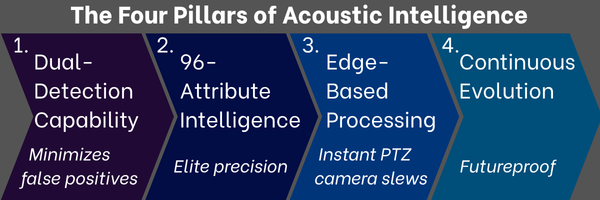
The Four Pillars of ATD Acoustic Intelligence
1. Dual-Detection Capability: Can use shockwave-enhanced muzzle blast detection to analyze acoustic signatures for gunshot verification.
2. 96-Attribute Intelligence: Evaluates waveform, spectral, ballistic, and statistical characteristics to eliminate daily operational noise.
3. Edge-Based Processing: Processes all classification onboard the sensor with zero latency to immediately trigger PTZ camera slewing.
4. Continuous Acoustic Evolution: Deploys expert-refined algorithms periodically so your system grows smarter the longer it is in the field.
Book a Technical System Demonstration
See how the ATD edge-processing engine integrates with your existing camera infrastructure.
👇Explore the Full Technical Detail the 4 Pillars of Acoustic Intelligence and Waveform Anatomy
Deconstructing the Science: The 4 Pillars of Acoustic Intelligence
1. The Dual-Detection Capability (Enhanced Reliability through Physical Verification)
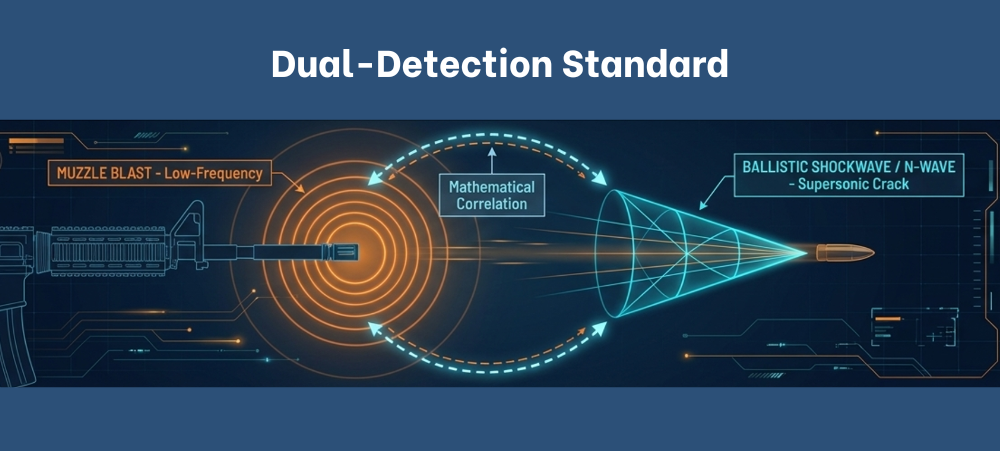
The ATD-300 delivers exceptional accuracy by deciphering the complete acoustic signature of a gunshot by combining a Dual-Detection Capability with 96-Attribute Intelligence. Unlike legacy microphone-only systems, ATD establishes a Dual-Detection Capability that can utilize a ballistic shockwave-enhanced muzzle blast for mathmatic analysis of an acoustic signature. These distinct signatures provide the physical audio verification of a gunshot and significantly reduce false alarms, giving security teams the confidence to immediately assess and react to verified threats.
Relying on decibels (loudness) alone creates a “noisy” system prone to false alarms. True reliability requires Active Acoustic Pattern Matching: identifying the specific characteristics of a soundwave and comparing it to the acoustic signatures of gunshots and other environmental noise. Success requires top-of-the-line hardware such as is in the ATD-300 sensor, deep expertise in the science and analysis of acoustics, and an extensive gunshot library built from decades of actual field experience. While some commercial systems train their models using clean, artificial gunshot audio downloaded from internet databases, Acoem’s neural network is trained on a massive, proprietary library of actual field data, including battle-proven military and combat files captured over 30 years of operations. This real-world acoustic data ensures the system remains highly sensitive to genuine threats while maintaining best-in-class reliability in chaotic outdoor environments.
2. 96-Attribute Intelligence (Elite Precision via AI Neural Networks)
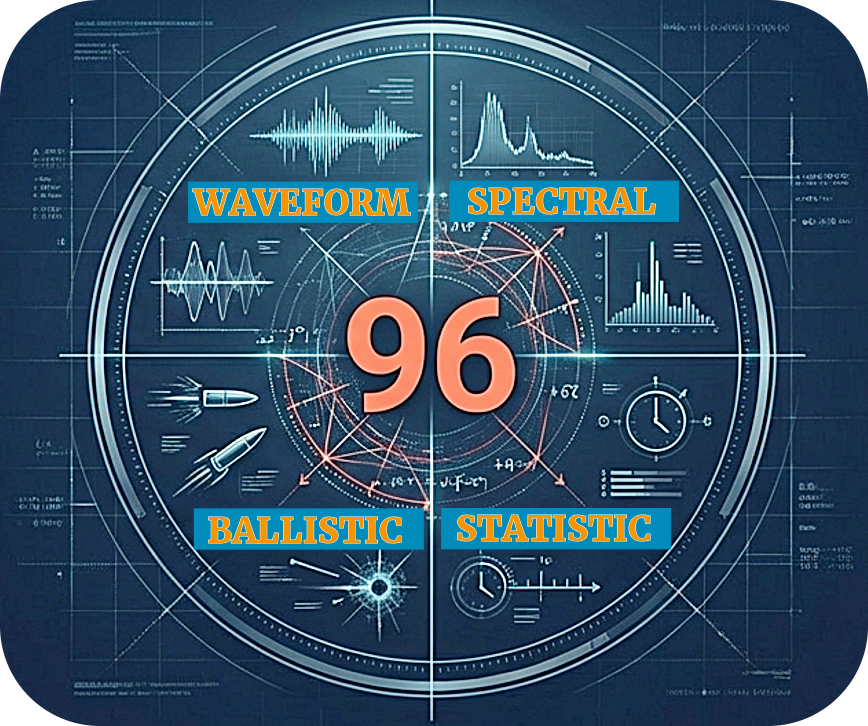
At the heart of the ATD-300 sensor is a proprietary 96-Attribute Acoustic Intelligence Engine. By analyzing 96 distinct characteristics across waveform, spectral, ballistic, and statistical data categories, the system distinguishes gunfire from environmental noise—such as construction, car backfires, or fireworks—with unmatched precision.
In the real world, sound bounces off roads, walls, and hills; this is known as multipath interference. Legacy mesh systems with simple decibel-based sensors easily get confused by these echoes, leading to false locations. Through its advanced time-windowing ability, the ATD sensor filters out this “multipath” interference, ensuring the system identifies the actual source of the shot rather than a reflection. In addition, the ATD sensor’s intelligence happens within a sophisticated AI neural network that performs edge-based processing occurring entirely within the sensor, completely eliminating the need for complex servers or cloud dependency.
3. Edge-Based Processing (Immediate PTZ Camera Slewing & Real-Time Response)
Speed and civil liberties are the twin cornerstones of the ATD-300’s Edge-Based Processing architecture. By performing complex acoustic analysis directly on the sensor’s onboard processor, all classification and localization are processed entirely onboard the hardware to achieve instant threat detection with near-zero latency.
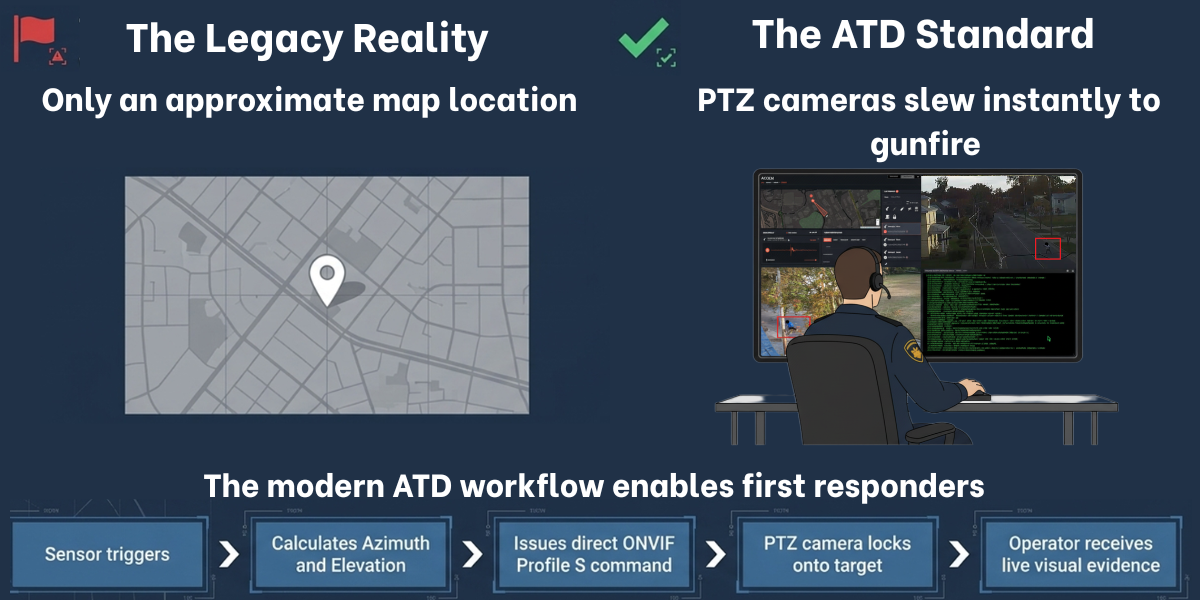
This speed is critical for immediate PTZ camera slewing. The moment a shot is fired, the sensor calculates the precise location coordinates and issues a direct command to automatically slew, lock, and target connected PTZ cameras to the event for real-time visual verification. With zero latency, this architecture sends audio alerts and triggers camera slewing immediately, even in air-gapped or remote environments, giving first responders the ability to rapidly assess, verify, and react to a threat.
Beyond unmatched tactical speed, this “at-the-source” intelligence delivers a true Privacy-by-Design solution that addresses the public anxiety surrounding pervasive civic surveillance. Unlike legacy systems that require constant audio streaming to a central server, the ATD-300 operates on a strict, event-driven framework. The system passively listens only for the specific physical blueprint of a ballistic threat, meaning everyday background sounds and human conversations remain completely unrecorded and unanalyzed.
Only when a significant acoustic trigger matches a ballistic profile does the onboard processor capture a brief 1.5-second audio clip strictly for verification. Because the entire mathematical evaluation occurs inside the sensor, the system eliminates cloud dependency for the initial trigger, significantly reduces bandwidth consumption, and ensures that only encrypted metadata ever leaves the device. The ATD-300 proves that municipalities and corporate campuses do not have to choose between public safety and public privacy, providing a faster, more secure response that empowers security teams while protecting the community.
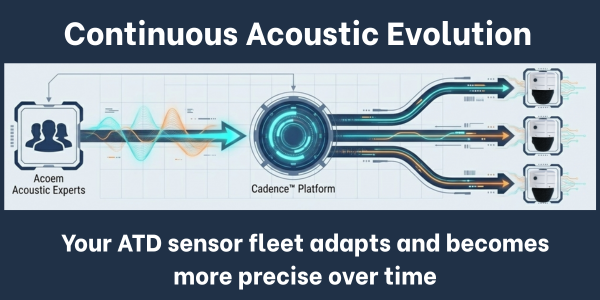
4. Continuous Acoustic Evolution (Future-Proofing Your Investment)
Your security stack becomes more precise over time through Continuous Acoustic Evolution. Acoem’s team of acoustic experts continuously monitors field data across global deployments to identify new sound profiles and refine our threat detection algorithms.
Rather than allowing unpredictable, automated updates to run unvetted in the background, Acoem delivers expert-refined performance packages typically released several times a year. These targeted AI updates are pushed through the Cadence™ platform, allowing your IT and security teams to deploy them to your sensor fleet completely at your convenience and as desired. This architecture gives you absolute configuration control while ensuring your system never becomes obsolete, adapting to complex environmental changes entirely on your terms.
From Technical Standard to Real-World Protection
Don’t guess. Verify. See how Acoem’s single-sensor architecture significantly minimizes false alarms and instantly commands PTZ camera automation in real time.
Schedule a Live Infrastructure Strategy Call
Decoding the Signal: The Anatomy of a Ballistic Waveform
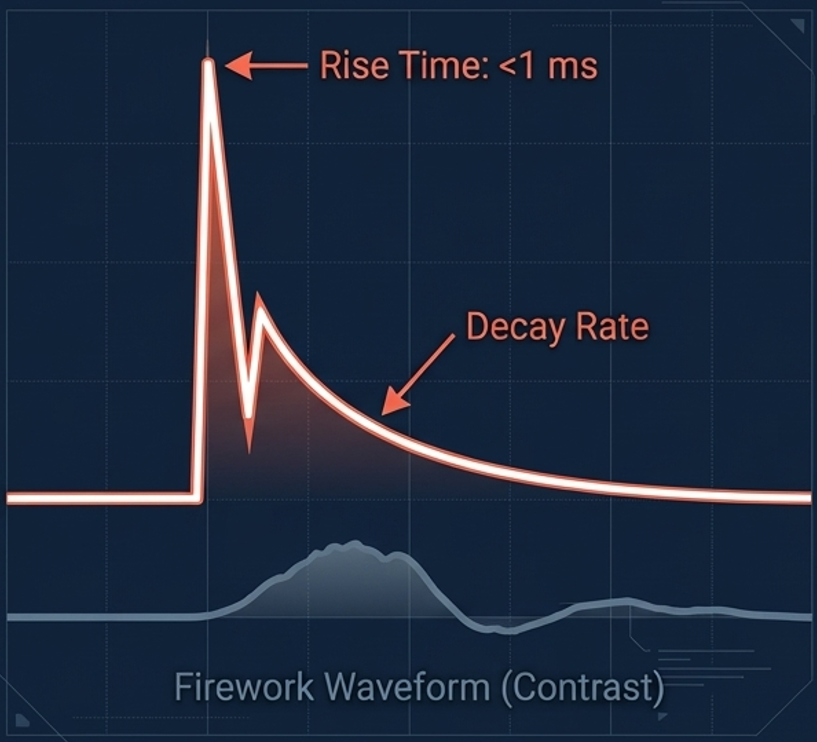
Phase 1: The Muzzle Blast (The Acoustic “Boom”)
When a firearm discharges, the rapid expansion of high-pressure gases from the barrel produces an intense, omni-directional sound wave.
-
The Waveform Envelope: Unlike continuous construction noise or rhythmic vehicle engines, a true muzzle blast features a near-instantaneous rise time of less than 1 millisecond (1 ms), hits a sharp peak overpressure, and decays at a strict exponential rate.
-
Spectral Evaluation: The system evaluates many features of the waveform envelope, including rise time, peak overpressure, decay rate, and positive phase duration, This allows it to immediately differentiate the specific acoustic energy of a firearm from non-ballistic impulsive noise.
Phase 2: The Supersonic Shockwave (The Ballistic “Crack”)
Most modern ammunition projectiles travel faster than the speed of sound, creating a distinct “Mach cone” or ballistic crack as they pass through the air.
-
The N-Wave Profile: This supersonic motion generates a highly specific “N-wave” pressure signature—characterized by a razor-sharp rise in pressure followed by an immediate, rapid drop.
-
The Verification Loop: This high-frequency crack is a definitive physical fingerprint of a bullet in flight; mechanical sounds like fireworks or heavy door slams completely lack this supersonic signature. Advanced systems can calculate the precise time-difference between this shockwave and the muzzle blast to verify the event with absolute certainty.
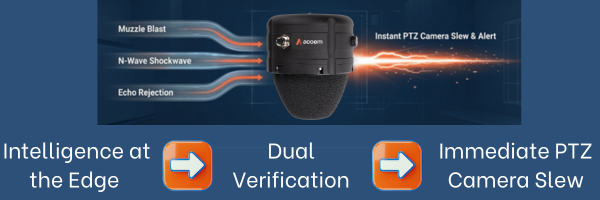
Phase 3: Acoustic Propagation & Multipath Echoes
In real-world outdoor environments, sound waves inevitably strike hard surfaces like asphalt roads, concrete walls, and rolling hills, causing the sound to bounce.
-
Filtering Multipath Interference: Simple decibel-meters easily get confused by these reflections, resulting in inaccurate tracking and false location targets.
-
Time-Windowing Precision: The ATD-300 sensor utilizes advanced acoustic time-windowing to filter out this “multipath” interference. By isolating and discarding the echoing reflections, the sensor identifies the true, original source of the gunshot rather than a misleading bounce.
The Bottom Line:
Relying on decibels alone creates a “noisy” system prone to false alarms. True reliability comes from Acoustic Pattern Matching: identifying the specific characteristics of a soundwave and comparing it to the acoustic signatures of gunshots and environmental noise. Success requires top-of-the-line hardware, large datasets of pre-recorded audio, and deep expertise in the science and analysis of acoustics.
Security Decisions Should Be Black & White
In an industry filled with marketing noise, Acoem provides absolute clarity. Whether you are a consultant designing a modern perimeter or a municipality looking to protect community privacy, our technical team is ready to map out your specific deployment footprint.
